
Updated: October 29, 2025

If you’re looking for an advisor who goes beyond just “how much tax will I owe this year?” and actually incorporates tax-smart strategies into your financial plan, the Tax Planning Certified Professional® (TPCP®) Program can be a meaningful differentiator. This designation shows the advisor has received focused training in long‑term, proactive tax planning—not just compliance. For you as a client, that means your advisor is better equipped to address how taxes affect your investments, retirement income, estate plans, and business decisions over your lifetime.
The TPCP® credential is offered by The American College of Financial Services and is described as the “only tax‑planning‑focused designation of its kind.”
Here’s what to know:
Many investors expect their advisor to help reduce tax drag, yet advanced tax strategies are often under‑emphasized. For example:
Tax laws are evolving, business‑owner issues are increasingly involved, and retirement withdrawal strategies (e.g., Roth conversions, HSAs, handling multiple income streams) require thoughtful planning. The TPCP® curriculum addresses these, which means your advisor is more likely to be proactive rather than reactive.
For example, when you’re transitioning to retirement, or when a business sale is on the horizon, having a tax‑aware advisor can help you avoid surprise tax bills or missed opportunities.
A TPCP®‑trained advisor is positioned to go beyond generic “we’ll do your taxes” and instead:
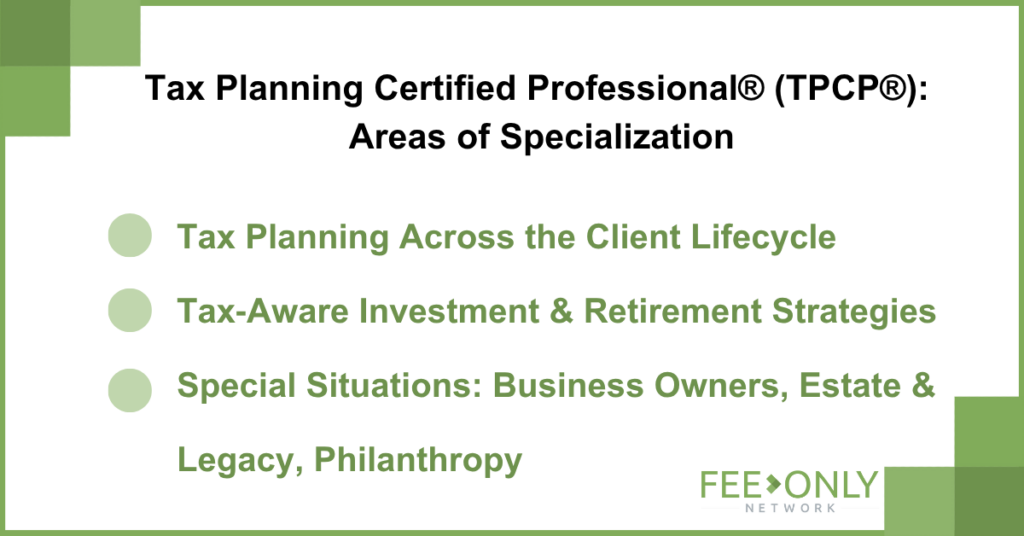
Advisors must complete a three‑course online program offered by The American College. Requirements include:
If you’re looking to work with an advisor who brings tax‑aware strategies into your broader financial plan, the TPCP® designation is a strong signal of that capability. It shows the advisor understands that tax planning isn’t a sideline—it’s central to accumulating wealth, generating retirement income, preserving your legacy, and adapting to life changes. While the credential doesn’t guarantee perfection, it increases the odds your advisor is equipped for a tax‑smart conversation.
The TPCP® designation is governed by The American College of Financial Services. For more details, visit: The American College. They oversee the curriculum, standards, and integrity of the program.
Q: What exactly does “tax‑aware planning” mean in this context?
A: It means your advisor considers how your decisions now—like asset placement, account type, retirement withdrawal timing, business sale, or estate gifts—affect your tax liability over your lifetime, rather than just preparing this year’s tax return.
Q: Does an advisor have to hold the TPCP® designation to give good tax advice?
A: No, many advisors offer strong tax‑planning advice without this credential. But having TPCP® suggests the advisor sought specialized training focused on tax planning for individuals and businesses—not just compliance.
Q: Does the TPCP® cover tax return preparation or represent you before the IRS?
A: No. The TPCP® focuses on tax‑planning strategy (how tax affects your financial decisions), not tax return preparation or audit representation. That remains the role of CPAs or Enrolled Agents.
Q: Is the designation expensive or time‑consuming for an advisor?
A: The program is described as comprising three online courses and can be completed in under five months according to the listing.
Q: As a client, how should I use this information?
A: Use it as one factor in understanding your advisor’s focus. Ask how they integrate tax planning into your financial plan, and how they stay current with tax law. The TPCP® designation helps signal someone committed to that dimension.




Allan Slider is the Founder of FeeOnlyNetwork.com, a one-of-a-kind digital platform that elevates the visibility of fee-only financial advisors, individually and collectively. Fee-Only advisors are ONLY compensated by the client and NEVER make commission by selling financial products, or receiving kickbacks from brokerage firms. Allan is a consumer & investor advocate and a 20+ year veteran of online marketing for financial advisors.

If you're seeing this message, it's because the web browser you're using to access our site is much older and no longer supported. Due to privacy and safety concerns, we don't allow older browsers to access our site. In order to access WhyFiduciary.com, please use a newer browser, like Internet Explorer 10 or above, Google Chrome, or Mozilla Firefox.
Download a newer browser